
At Newstripe, customer driven innovation starts with listening. The people using our equipment every day understand where time is being lost, where a process could be simpler, and where an existing machine could do more. Those conversations help our team identify opportunities to improve our products and develop new equipment around real-world needs.
For more than 40 years, product innovation, quality manufacturing, and robust customer relationships have been central to how we operate. Rather than developing equipment based solely on what looks good on paper, we pay attention to how customers actually use our products. Two recent examples are the LineRider™ Deluxe UTV Mounted Airless Line Striper and the AeroVent® Crush 3X Aerosol Can Disposal System. These recent product innovations show how customer feedback can turn into practical product improvements.
What Does Customer Driven Innovation Mean at Newstripe?
For Newstripe, customer driven innovation means developing equipment with the end user in mind from the beginning.
Customers regularly tell us what is working, what could work better, and what would make their jobs easier. Sometimes that feedback leads to an improvement to an existing product. Other times, it identifies an opportunity for an entirely new solution.
Our goal is to solve real problems, streamline processes, and help customers get more value from the Newstripe equipment they use.
LineRider Deluxe: Turning Equipment Customers Already Own Into a Line Striper
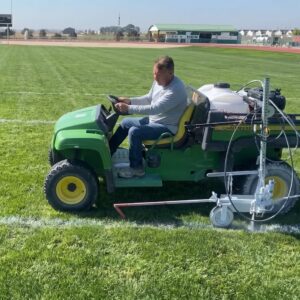
One of the ideas behind the LineRider Deluxe came directly from understanding what many athletic field customers already had available: a UTV.
Customers wanted the speed and convenience of a riding line striper, but many already owned utility vehicles for other field maintenance work. That raised a simple question: why require another dedicated vehicle when the equipment they already own could become part of the solution?
That feedback helped shape the LineRider Deluxe UTV Mounted Airless Line Striper.
Instead of creating a basic UTV attachment with paint buckets, our team reconfigured the system around ease of use, capacity, and quick conversion. The LineRider Deluxe slides into the bed of most popular UTVs, allowing customers to convert an existing vehicle into a riding field striper and remove the system when the UTV is needed for something else.
The finished design includes:
- A 25-gallon paint tank that reduces refill stops
- Striping speeds of up to 8 mph
- A floating caster to help maintain line width over uneven ground
- A 2.5-gallon purge tank for easier cleanup
- A removable spray gun with a 25-foot hose for stencils, curves, and hard-to-reach areas
That is customer driven innovation in practice: start with what customers already have, understand what they need to accomplish, and develop a more efficient and affordable way to connect the two.
AeroVent Crush 3X: Taking an Existing Process One Step Further
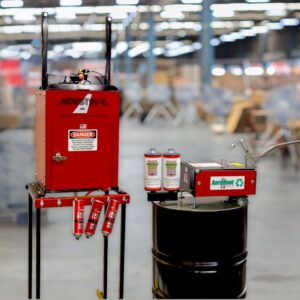
Our AeroVent aerosol can disposal systems were designed to puncture and depressurize used aerosol cans so they could be properly managed for disposal or recycling. But customers kept asking for a way to take the process further.
They didn’t just want to safely puncture and drain cans. They wanted one system that could puncture, drain, and crush them.
The result was the AeroVent Crush 3X Aerosol Can Disposal System, which combines two Newstripe technologies into one integrated waste-handling process.
Users can puncture and drain up to three aerosol cans at a time and then crush the processed cans. Compaction can reduce can waste volume by up to 75%, helping streamline storage and disposal.
The system also incorporates features such as the Viz-a-Ball safety indicator, Enhanced Dual AeroVent Safe2Vent filter system, and compatibility with aerosol cans up to 3 inches in diameter and 10.5 inches long.
Instead of asking customers to manage separate pieces of equipment and separate steps, we expanded our existing technology to create a more complete workflow.
Why Customer Feedback Matters During Product Development
These products serve completely different markets, but their development follows the same principle.
With the LineRider Deluxe, customers helped us recognize an opportunity to make equipment they already owned more useful. With the AeroVent Crush 3X, customers showed us that an existing disposal process could be expanded into a more complete solution.
That feedback gives our product development team something extremely valuable: insight from people doing the work.
Customer driven innovation helps us focus on practical questions:
- Can we eliminate an unnecessary step?
- Can existing equipment perform another job?
- Can we make setup, operation, or cleanup easier?
- Can multiple processes be combined?
- Can an established Newstripe product be improved based on how customers actually use it?
Those questions keep product development focused on useful improvements rather than features that add complexity without solving a problem.
Customer Driven Innovation Does Not Stop at Launch
Launching a product isn’t the end of the process at Newstripe. We continually listen to our customers and dealers after equipment reaches the final destination.
That customer feedback empowers our team to listen to real-world examples of how our machines perform in different applications and where future improvements can be made. In fact, Newstripe has previously incorporated customer and dealer feedback into product enhancements, including revisions to our airless line stripers.
For Newstripe, customer driven innovation is an ongoing cycle: listen, identify a need, develop a solution, learn from how it performs, and continue improving.
The LineRider Deluxe and AeroVent Crush 3X are two recent examples, but the philosophy extends across Newstripe. When customers tell us there is a better way to get a job done, we want to hear it. Those conversations help us build equipment around the people who actually use it.